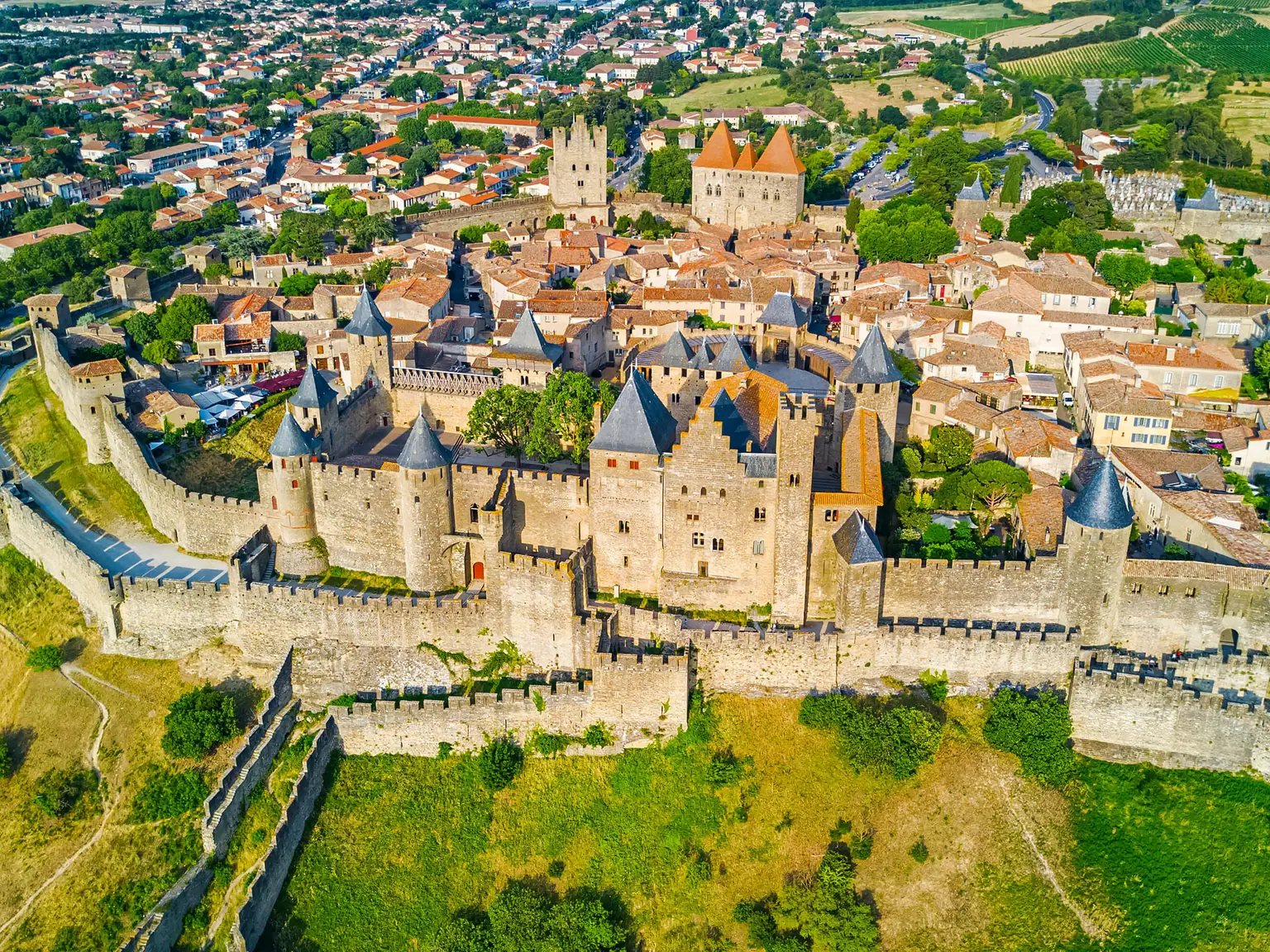
The short answer: in Carcassonne you can walk through the medieval gates, stroll along the fortress walls and through the accessible stretches of the space between them for free. To climb onto the walls and walk along the top, though, you need a ticket for the Château Comtal.
The scale: two lines of fortifications about three kilometres long in total, with 52 towers. Carcassonne is one of the most impressive surviving — and restored — medieval fortified towns in Europe. Its double walls and the major 19th-century restoration were key reasons the Cité was added to UNESCO's World Heritage List in 1997.
A little history, so you know what you're looking at. The inner ring stands on late-Roman foundations: Carcassonne was already a fortified town in the 4th century. The French crown added the outer ring after 1226, when the city came under its rule. Later the border with Spain moved south, the fortress lost its military role and fell into decline: for a long time it was used as a quarry, walls and towers were gradually taken apart, and the fortifications faced the threat of demolition. The historian Jean-Pierre Cros-Mayrevieille and the writer and inspector of historic monuments Prosper Mérimée fought to save them — the Cité's main street is named after Cros-Mayrevieille today. In the mid-19th century a large-scale restoration began under Viollet-le-Duc. So the fortress you see is medieval stone as the 19th century read it.
Telling these layers apart on site isn't easy, and that's where a TouringBee audio walk helps: about two hours through the free part of the Cité, with a ready-made route, map and audio fully offline. It follows the free route and doesn't replace the ticket for the wall-walk.
- Length & towers
- two lines, ~3 km in total · 52 towers
- Free
- both main gates, accessible stretches of the lices, views from outside
- Ticketed
- the wall-walk on the inner ring (included in the Château Comtal ticket)
- Wall-walk
- ~1.3 km · access by the Porte Narbonnaise and the Tour des Prisons
- Viewpoints
- Pont Vieux, the right bank of the Aude, the eastern approach
- Audio guide
- ~2 h · offline · free route · €9.99
- Inner ring — the wall-walk on top needs a ticket
- The lices between the walls — free (accessible stretches)
- Outer ring
- 1Porte Narbonnaise — main gate, free
- 2Porte d'Aude — towards the river, free
- 3Château Comtal — ticketed, access to the wall-walk
- 4Pont Vieux — the classic view of the walls
Some stretches of the lices may be closed for works or events — plan an out-and-back walk rather than a full loop.
How the double walls work
Carcassonne is defended by two rings. The inner one is higher and older, with a Roman base. The outer one is lower and was built in front of it in the 13th century: even after breaking through the first line, an attacker was still under fire from the second. The space between the rings is called the lices. It let defenders move along the fortifications and served as an extra line of defence. It's divided into the lower and upper lices (lices basses and lices hautes), following the slope of the hill. By the 19th century houses had been built between the walls; they were cleared during the restoration.
The towers on the two rings differ, and you can see it without any background. On the inner ring, Gallo-Roman towers survive — lower, rounded, built of small stones crossed at regular intervals by bands of red brick. The medieval towers are bigger, of dressed stone, with arrow slits. A striking example of the royal period is the Porte Narbonnaise and the Tour du Trésau beside it, from the late 13th century. What sits on top — roofs, battlements, wooden galleries — was largely added during the 19th-century restoration.
Why the towers have those roofs
The conical slate roofs are the first thing you remember, and they give Carcassonne its slightly fairy-tale look. Viollet-le-Duc put them there, and he was criticised for it already in the 19th century: roofs like these belong to northern France, while here in the south buildings were covered with low-pitched tiles. The architect pointed to the slate quarried in the Montagne Noire, less than 50 km from the city.
The argument isn't about whether slate was available, but about historical accuracy: did Viollet-le-Duc restore what stood here in the Middle Ages, or finish the fortress the way he believed it ought to have looked? Look closely: the roofs aren't all the same — beside the sharp slate cones you'll spot lower, tiled ones.
What you can see for free
Without a ticket you get everything that can be seen from the ground. Entering through the Porte Narbonnaise is the main and most dramatic way in: two towers, a drawbridge and the barbican in front. On the west side, the Porte d'Aude leads down towards the river — a steeper, quieter way into the Cité that takes you to the Pont Vieux. Between the rings you can walk the accessible stretches of the lices: towers rise on both sides and there are noticeably fewer people than on the main street. The easiest way in is right after the outer Porte Narbonnaise. Some stretches are closed from time to time for works or events, so plan an out-and-back walk rather than a full loop. And the best free sight of all is the walls themselves, seen from outside.
What only the ticket opens
You can only climb onto the walls with a Château Comtal ticket: it includes the wall-walk along the top of the inner ring. Since the 2022–2024 restoration it has been open as a full circuit — about 1.3 km past 35 towers, with two access points: by the Porte Narbonnaise and by the Tour des Prisons. From up there you can see how the defence worked: both rings at once, the lices below you, the approaches to the city, the lower town and, on a clear day, the Pyrenees.
What else the ticket includes, what it costs and how to plan the visit — see our Château Comtal guide. Prices and concessions are on the official site, remparts-carcassonne.fr; you can also book a timed ticket online via Tiqets.
Where to see and photograph the walls
You can't take in the whole double ring from inside — you need to step back. The classic view is from the Pont Vieux and the right bank of the Aude, on the lower-town side: from there you see the west front, both rings, the towers and the castle above them. By day it's about the silhouette and the scale; in the evening the walls are lit, and that's when the best-known shots of Carcassonne are taken. Another good angle is the eastern approach to the Porte Narbonnaise, where the barbican and the double line of walls are clearly visible. And inside, in the lices, shoot upwards along the walls — that's where the difference in masonry and height between the two rings shows best.
How and when to see the walls
The best times are early morning and evening: soft light and fewer people in the lices and on the bridge. At midday in summer the stone is hot and there's hardly any shade.
A simple free route: enter through the Porte Narbonnaise, turn into the lices and walk as far as they're open, come back to the gate, cross the Cité to the Porte d'Aude and walk down to the Pont Vieux. That way you see the walls from inside and out without risking a dead end at a closed stretch. Wear comfortable shoes: cobbles, slopes and steps.
Carcassonne was built and rebuilt over 1,500 years. Learn to see the difference
Roman towers, medieval fortifications, Viollet-le-Duc's restoration — they all stand side by side, often within a single wall, and without someone pointing them out they blur into one pretty picture.
The TouringBee audio guide takes you through the Cité and tells you what lies behind the stones: each story starts at its own spot, and once downloaded the map and audio work offline. It follows the free route and doesn't replace the ticket for the wall-walk.

€9.99 one payment · 1 year access
Helps you read the walls as you walk the free Cité — each story at the place it belongs. It doesn't replace the wall-walk ticket.
- ~2 hours · 8 languages
- Offline map and audio
- Each story starts at the spot
- Free route · no group, no schedule
FAQ
Carcassonne walls — questions
Can you walk the walls of Carcassonne for free?
Along the walls, yes: the gates, the accessible stretches of the lices between the rings and the views from outside are free. Climbing onto the walls and walking along the top needs a Château Comtal ticket.
How many walls and towers does Carcassonne have?
Two lines of fortifications, about 3 km in total, with 52 towers. The inner ring stands on a late-Roman base; the outer ring was added in the 13th century.
What are the lices?
The space between the inner and outer rings of walls. It let defenders move along the fortifications and served as an extra line of defence. Today you can walk the accessible stretches for free.
Where is the best view of Carcassonne's walls?
The classic view is from the Pont Vieux and the right bank of the Aude, on the lower-town side. In the evening, when the walls are lit, it's especially striking.
Are Carcassonne's walls original or rebuilt?
Both. The base is Roman and medieval, but in the 19th century Viollet-le-Duc restored the fortress on a large scale, and the conical slate roofs of the towers were his decision — their historical accuracy is still debated.
How much does it cost to walk on the walls?
The wall-walk is included in the Château Comtal ticket: €13 (Oct–Mar) and €19 (Apr–Sep), free for under 18s. Other concessions and current prices are in our Château Comtal guide and on remparts-carcassonne.fr.
Continue exploring
More Carcassonne guides
Château Comtal
Is the ticket worth it?
What to See in Carcassonne
The sights that earn your time.
One Day in Carcassonne
The full plan, hour by hour.
Best Time to Visit
Weather, crowds and events.
Some links on this page are affiliate links (Tiqets, and the TouringBee audio guide). If you book through them we may earn a small commission at no extra cost to you. We only recommend what we would use ourselves.
In short
For free, you can walk through the gates, stroll the accessible stretches of the lices and see the fortress from outside — from the Pont Vieux and the banks of the Aude. The ticket is only for the walk along the top of the walls: it's worth it if you want to see the defences from above. And to tell Roman masonry from medieval and 19th-century work, take the TouringBee audio guide with you: about two hours, offline, no group, no schedule.